

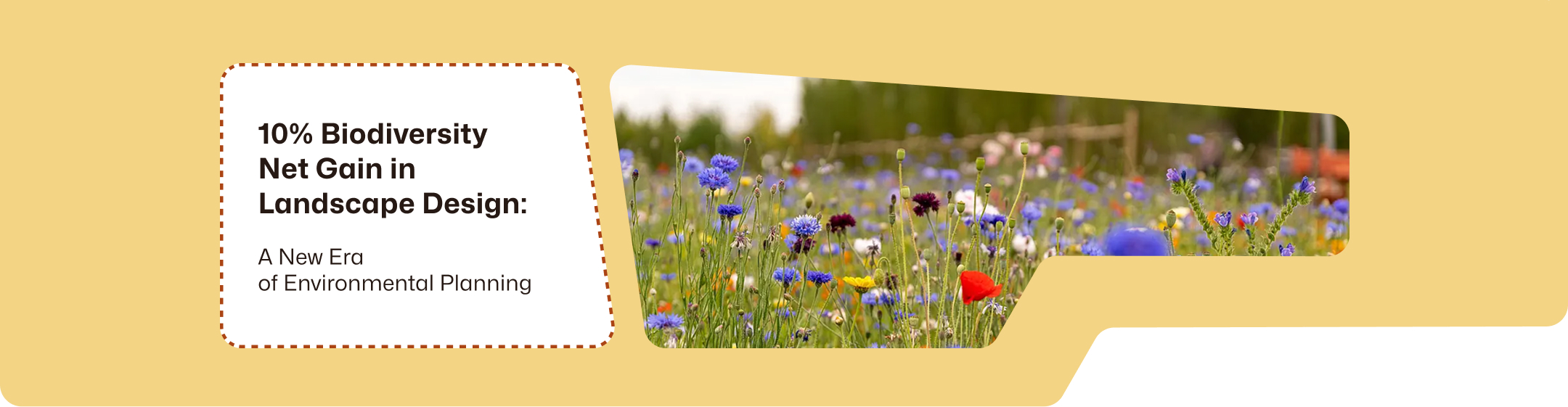
Planning Requirements For New Homes – 10% Biodiversity Net Gain

In the contemporary realm of Landscape Design and Management, a new term has emerged and is taking the industry by storm: Biodiversity Net Gain (BNG). This game-changing concept, mandated by the 2021 Environment Act, is now a compulsory element in the planning process for new developments, reshaping Landscape Planning and the design process on a national scale.
As we explore the ins and outs of the 10% Biodiversity Net Gain, we’ll uncover how this concept has the power to create a more balanced and sustainable future, painting a new picture for the landscapes of tomorrow.
What is Biodiversity Net Gain?
The Local Government Association define Biodiversity Net Gain (BNG) as an initiative aimed at enhancing the natural environment through development or land management, leading to richer biodiversity than what was originally present. Biodiversity refers to the diverse array of living species, including plants, animals, fungi, and bacteria, found on Earth. By considering both natural and man-made habitats, BNG is integral for maintaining an environment conducive to human life and sustainable economic activities.
2021 Environment Act
The 2021 Environment Act highlights BNG as a vital aspect of development, filling the gaps in environmental protection left by the UK’s departure from the EU. The Act outlines clear objectives concerning air quality, biodiversity, water and waste management, and reversing species decline.
Notably, it has set a target to reduce particulate matter concentrations (PM2.5), a pollutant highly detrimental to human health. This legislation addresses environmental protection from a perspective of social justice, acknowledging that pollution levels often disproportionately impact less advantaged areas.
Implications for Planning Requirements
The Act stipulates a new planning condition: a mandatory 10% net gain in biodiversity for all new developments. To demonstrate compliance, developers are required to submit a BNG plan to their local planning authority for approval before initiating any construction. This plan must detail an assessment
of the site’s natural habitats before and after the proposed development.
The concept of BNG is increasingly recognised across local planning authorities, with many setting
policies that exceed the 10% minimum requirement. Developers who integrate an effective BNG plan
into their proposals from the early stages are less likely to face objections on the grounds of ecological
harm or nature conservation.
Developers are advised to work with specialists to understand complex requirements like habitt quality and long-term maintenance. The Defra biodiversity metric is a standard tool used for measuring biodiversity in “units.” Developers can meet the BNG requirement either through on-site enhancements or approved off-site compensations, like contributing to a biodiversity register or buying biodiversity credits.

What Does This Mean for On-site Improvements?
In the context of Biodiversity Net Gain, on-site improvements are about enhancing and optimising the biodiversity within the development site. This approach involves fostering a healthier and more ecologically diverse environment within the premises. An effective strategy for on-site improvements considers every element of the site, from the soil composition to the flora and fauna that inhabit it.
For instance, the landscape may be designed to include more green spaces or to reintroduce native plant species that are beneficial for the local ecosystem. The site could also incorporate features such as rain gardens, bioswales, or green roofs that provide habitat while also contributing to other ecological functions. Additionally, it’s possible to provide nesting sites for birds, bats, and insects within the construction design, further boosting the site’s biodiversity.
However, on-site improvements must be planned carefully to ensure that they don’t inadvertently harm existing ecological features. Therefore, a comprehensive ecological survey is usually conducted before work begins, which provides a baseline for measuring improvements and highlights any areas that require particular attention or protection.
Off-site improvements are measures taken outside the development site to compensate for unavoidable biodiversity losses within it. They are usually considered when it is not feasible to achieve the required biodiversity net gain solely through on-site actions. Off-site improvements are typically delivered in locations where they would contribute most to strategic biodiversity and ecosystem objectives.
